
Introduction
Artificial Intelligence (AI) is rapidly transforming industries, creating new career opportunities across technology, business, healthcare, marketing, and beyond. As interest in AI careers grows, many learners focus heavily on earning certifications to demonstrate their knowledge.
While certifications are useful for validating theoretical understanding, employers increasingly prioritize practical experience and real-world problem-solving ability. This shift has made AI internships more valuable than ever in building a successful career.
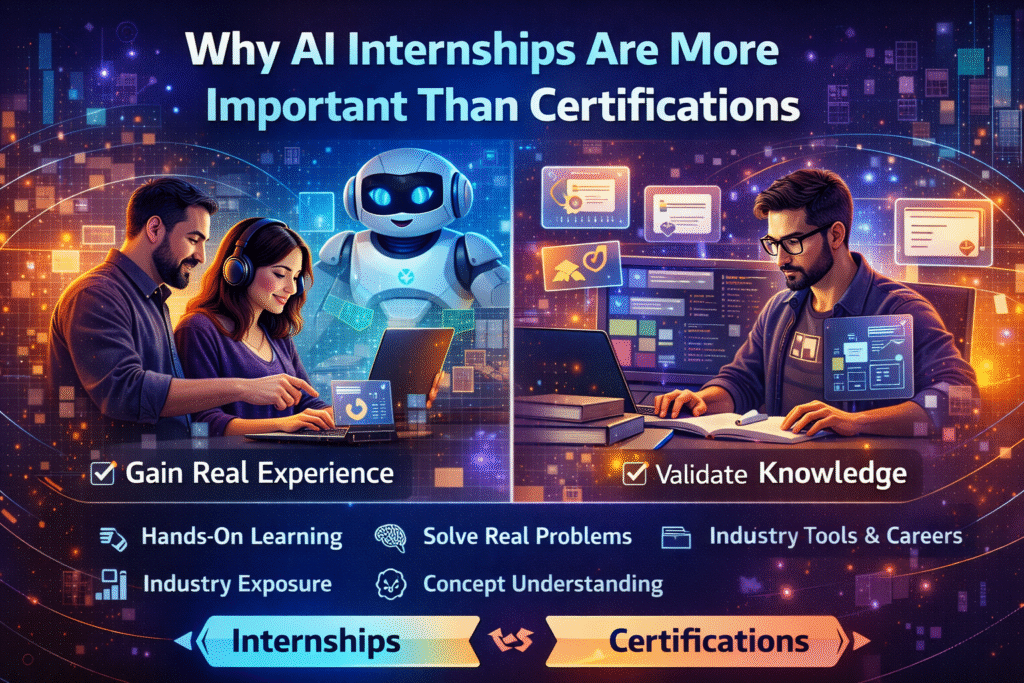
Certifications vs Internships: Understanding the Core Difference
Certifications primarily indicate that a learner has completed a course or mastered specific concepts. They reflect structured learning but may not always demonstrate the ability to apply knowledge in real scenarios.
Internships, however, bridge the gap between learning and execution.
✔ Certifications – Showcase theoretical knowledge
✔ Internships – Demonstrate practical capability
In a competitive AI job market, this difference becomes a decisive factor.
Why Practical Experience Matters More in AI Careers
Artificial Intelligence is a deeply applied discipline. Success in AI roles depends not only on understanding algorithms but also on solving real business problems, working with imperfect data, and adapting to practical constraints.
AI internships provide exposure to:
✔ Real datasets and challenges
✔ Live project environments
✔ Industry tools and workflows
This hands-on experience helps learners develop skills that cannot be fully acquired through certifications alone.
How AI Internships Accelerate Skill Development
Unlike classroom-style learning, internships immerse learners in dynamic, real-world situations. Interns must analyze problems, test solutions, and collaborate with teams.
Through internships, learners build:
✔ Data analysis and preprocessing skills
✔ Model development and evaluation experience
✔ Critical thinking and troubleshooting ability
✔ Communication and teamwork competence
These capabilities are essential for long-term career success.
Employer Perspective: Why Experience Reduces Hiring Risk
From an employer’s standpoint, certifications indicate knowledge, but experience indicates readiness. Candidates with internship exposure are often perceived as lower-risk hires because they have already worked in professional environments.
Internship experience signals:
✔ Ability to handle real projects
✔ Familiarity with industry tools
✔ Practical problem-solving skills
Which frequently outweighs multiple certificates.
The Role of Certifications in an AI Career Path
Certifications still play an important role in learning. They help beginners understand fundamental concepts such as machine learning, neural networks, and AI frameworks.
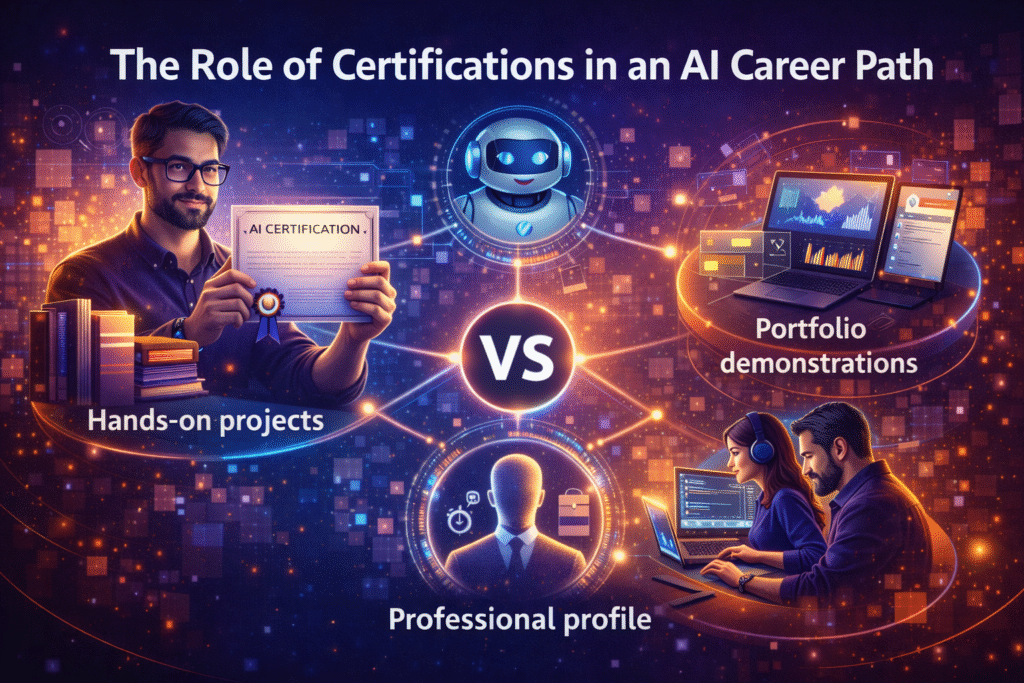
However, certifications become significantly more powerful when combined with:
✔ Hands-on projects
✔ Internship experience
✔ Portfolio demonstrations
Together, they create a well-rounded professional profile.
Balancing Learning and Practical Exposure
The most effective approach is not choosing between certifications and internships, but understanding their roles.
✔ Certifications build foundational knowledge
✔ Internships build applied expertise
Learners who combine structured learning with practical exposure often gain a strong competitive advantage.
Conclusion
In modern AI careers, practical experience is becoming the true differentiator. While certifications demonstrate what you have learned, internships demonstrate what you can actually deliver.
AI internships transform theoretical knowledge into real capability, making them a critical step for anyone serious about building a successful career in Artificial Intelligence.