
Introduction
Artificial Intelligence is evolving at an incredible pace, and one of the most significant advancements in recent years is the emergence of Large Language Models (LLMs). These models power modern AI systems capable of understanding and generating human-like text, making them valuable across industries, businesses, and digital applications.
Understanding Large Language Models (LLMs)
A Large Language Model (LLM) is an advanced AI system trained on massive volumes of text data. This training enables the model to recognize language patterns, interpret context, and generate meaningful responses.
LLMs are widely used in applications such as:
✔ AI chatbots
✔ Virtual assistants
✔ Content generation systems
✔ Code generation tools
✔ Business automation solutions
These capabilities make LLMs one of the most transformative technologies in modern AI.
What is LLM Training?
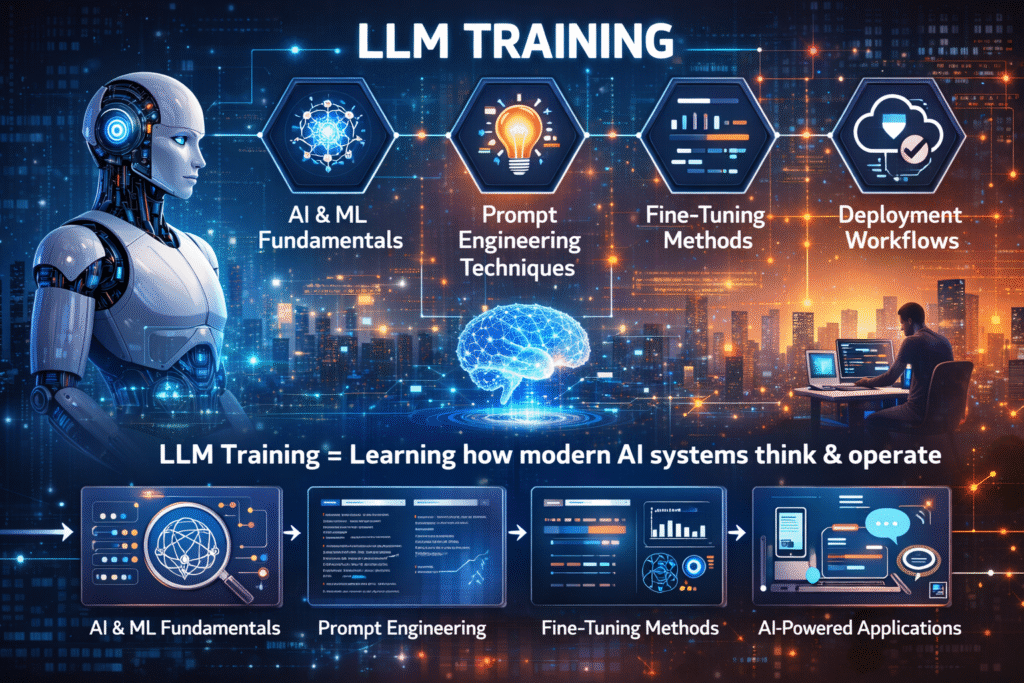
LLM Training refers to the process of learning how Large Language Models function, how they are developed, and how they can be applied to solve practical, real-world problems.
Unlike traditional academic programs, modern LLM training focuses on practical understanding rather than purely theoretical concepts. Learners gain exposure to working with AI systems used in real business environments.
A typical LLM training journey involves:
✔ Understanding AI & ML fundamentals
✔ Learning prompt engineering techniques
✔ Exploring fine-tuning methods
✔ Building AI-powered applications
✔ Understanding deployment workflows
In simple terms:
LLM Training = Learning how modern AI systems think and operate
Why is LLM Training Becoming Important?
The demand for LLM expertise is increasing rapidly as businesses integrate AI into their operations. From automating customer interactions to building intelligent AI copilots, LLMs are reshaping how organizations function.
Professionals with LLM skills are increasingly valuable because they can:
✔ Build AI-driven solutions
✔ Optimize model performance
✔ Design intelligent workflows
✔ Improve automation systems
This growing industry adoption directly impacts career opportunities.
What Do You Learn in LLM Training Programs?
A well-designed LLM training program usually progresses from fundamentals to advanced concepts, ensuring learners build a strong foundation.
Key learning areas often include:
✔ AI Foundations & Machine Learning Basics
✔ Transformer & LLM Architecture
✔ Prompt Engineering Strategies
✔ Retrieval-Augmented Generation (RAG)
✔ Fine-Tuning Techniques (LoRA / QLoRA)
✔ Vector Databases & Embeddings
✔ AI Model Deployment
This structured approach helps beginners gradually develop industry-relevant skills.
Who Should Learn LLM Training?
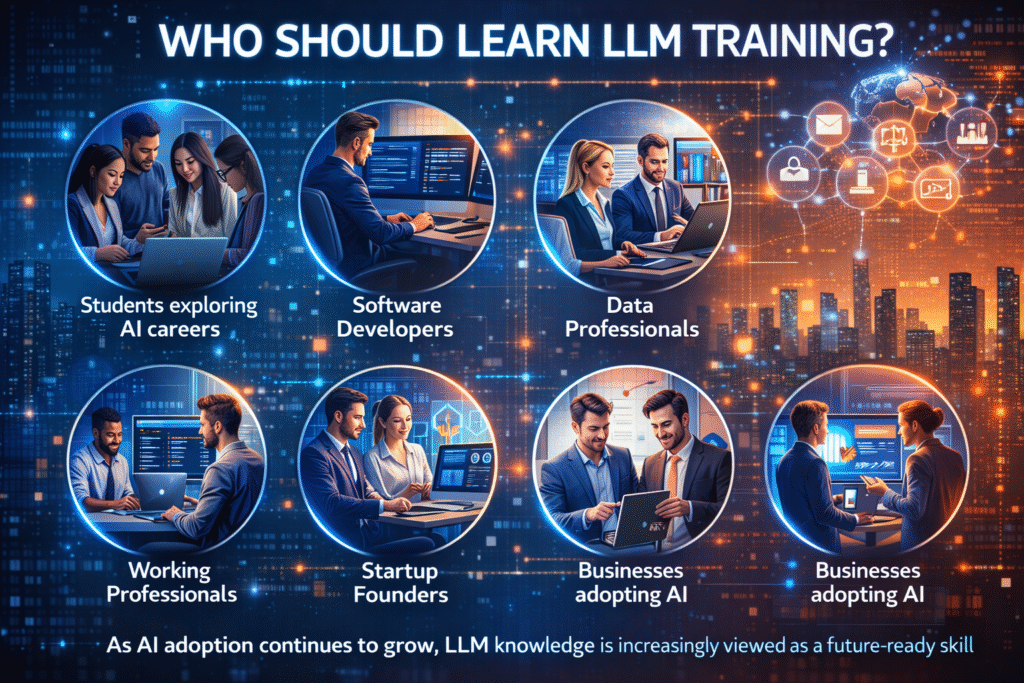
LLM training is no longer limited to AI researchers or data scientists. It is beneficial for a wide range of learners and professionals.
This includes:
✔ Students exploring AI careers
✔ Software developers
✔ Data professionals
✔ Working professionals
✔ Startup founders
✔ Businesses adopting AI
As AI adoption continues to grow, LLM knowledge is increasingly viewed as a future-ready skill.
Career Opportunities After LLM Training
Developing expertise in LLMs opens pathways to emerging AI-focused roles, including:
✔ LLM Engineer
✔ AI Engineer
✔ Generative AI Developer
✔ AI Architect
✔ AI Product Developer
With AI-driven technologies expanding rapidly, demand for these roles continues to rise.
Final Thoughts
LLM training is more than simply learning a new technology. It represents an opportunity to understand how intelligent systems are transforming industries, redefining careers, and driving innovation.
For anyone looking to enter the world of Generative AI, building knowledge in Large Language Models serves as a powerful starting point.