
Introduction
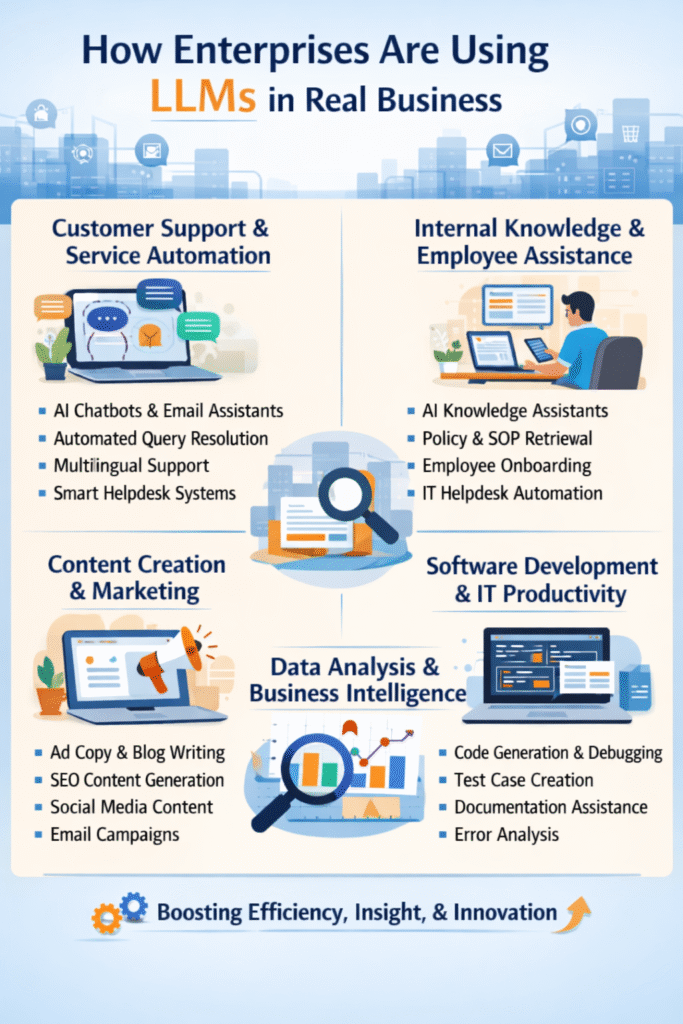
Large Language Models (LLMs) have rapidly transitioned from being experimental AI systems into practical business tools. Enterprises are no longer asking whether to use AI, but rather how to integrate it effectively. From improving customer interactions to accelerating internal operations, LLMs are reshaping how organizations function, compete, and scale.
Unlike traditional automation tools, LLMs bring contextual understanding, natural language interaction, and adaptive intelligence. This makes them valuable across multiple departments, not just IT. Let’s explore five major ways enterprises are using LLMs in real-world business environments.
1. Customer Support & Service Automation
Customer service is one of the most immediate and impactful areas for LLM adoption.
Key Uses:
- AI chat and email assistants
- Automated query resolution
- Multilingual customer communication
- Smart FAQ and helpdesk systems
LLMs enable businesses to handle high volumes of customer interactions while maintaining conversational quality. Instead of rigid rule-based bots, enterprises now deploy AI that understands intent, context, and tone. This improves response speed, reduces operational costs, and enhances customer satisfaction.
2. Internal Knowledge & Employee Assistance
Enterprises generate vast amounts of internal documentation and information.
Key Uses:
- AI-powered knowledge assistants
- Instant policy and SOP retrieval
- Employee onboarding support
- IT and HR helpdesk automation
LLMs act as intelligent interfaces over company knowledge bases. Employees can ask natural language questions rather than searching through systems manually. This significantly reduces friction, saves time, and improves overall productivity.
3. Content Creation & Marketing
Marketing and communication teams increasingly use LLMs to accelerate workflows.
Key Uses:
- Ad copy and campaign ideas
- Blog and SEO content drafts
- Social media variations
- Email marketing content
LLMs help enterprises produce high-quality drafts quickly, enabling faster campaign execution. Teams spend less time on repetitive writing tasks and more time refining strategy, creativity, and brand messaging.
4. Data Analysis & Business Intelligence
LLMs are making analytics more accessible across organizations.
Key Uses:
- Natural language data queries
- Automated report summaries
- Insight and trend explanations
- Simplified decision support
Rather than navigating complex dashboards, decision-makers can interact with data conversationally. LLMs translate numbers into understandable narratives, helping leaders make faster and better-informed decisions.
5. Software Development & IT Productivity
Technology teams use LLMs as productivity multipliers.
Key Uses:
- Code generation and debugging
- Documentation writing
- Test case creation
- Error analysis
LLMs reduce repetitive development tasks and accelerate problem-solving. This leads to faster release cycles, improved efficiency, and reduced development overhead without replacing human expertise.

LLMs are becoming foundational tools in modern enterprises, not isolated innovations. Their value lies in augmentation — enhancing human capabilities rather than replacing them. Organizations that adopt LLMs strategically are seeing gains in efficiency, scalability, decision-making, and customer experience.
However, success requires thoughtful implementation. Enterprises must balance automation with oversight, innovation with governance, and speed with accuracy. As LLM technology continues to mature, businesses that integrate it responsibly today will be better positioned to compete in an increasingly AI-driven landscape.