
Introduction
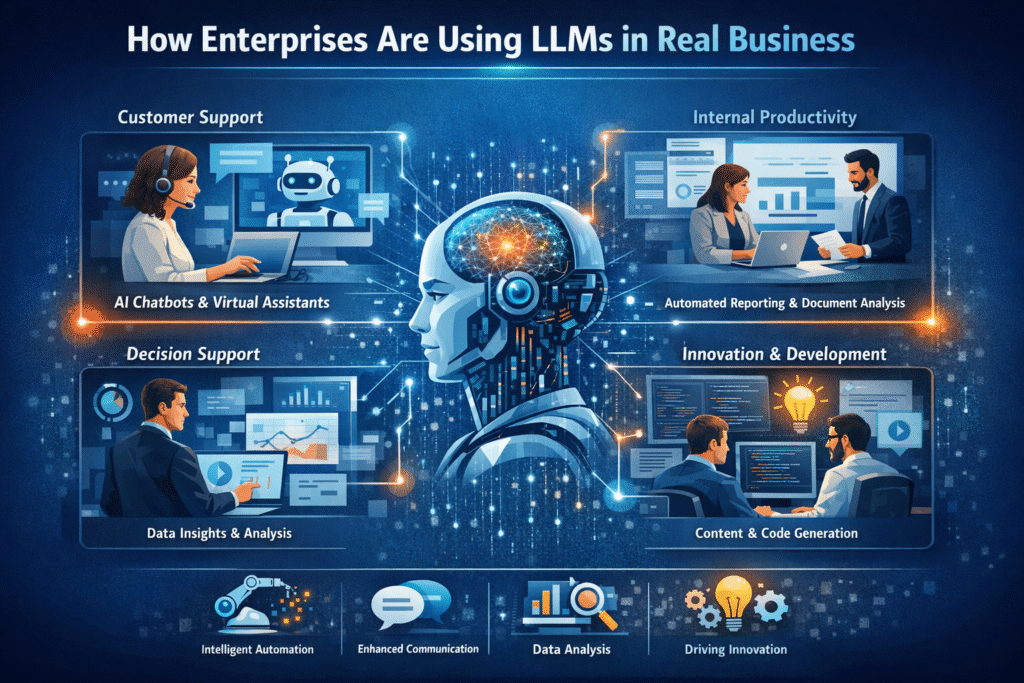
Artificial Intelligence has rapidly shifted from research labs into real business environments. Among the most transformative developments are Large Language Models (LLMs), which are redefining how enterprises operate, communicate, and innovate. Rather than serving as experimental tools, LLMs are now becoming practical assets integrated into everyday workflows.
Understanding the Business Value of LLMs
Large Language Models are designed to understand and generate human-like language, making them highly adaptable across enterprise functions. Their real strength lies in handling unstructured data, interpreting context, and supporting dynamic decision-making processes.
Enterprises leverage LLMs because they enable:
✔ Intelligent automation
✔ Scalable communication
✔ Faster information processing
✔ Enhanced decision support
This versatility makes LLMs valuable across departments rather than confined to a single use case.
Customer Experience & Support
Customer interaction is one of the most visible areas of LLM adoption. Enterprises deploy AI-powered assistants capable of managing inquiries, resolving issues, and delivering contextual responses.
Organizations benefit through:
✔ Reduced response times
✔ Lower operational costs
✔ 24/7 customer assistance
✔ More natural conversations
Unlike traditional rule-based systems, LLM-driven solutions provide adaptive, human-like engagement.
Internal Productivity & Efficiency
Inside enterprises, LLMs act as productivity enhancers by assisting employees with repetitive and information-heavy tasks. They streamline workflows without disrupting existing systems.
Common applications include:
✔ Document summarization
✔ Report generation
✔ Email drafting
✔ Knowledge retrieval
Even incremental efficiency improvements can produce significant operational gains at scale.
Business Process Automation
Enterprises increasingly embed LLMs into operational workflows to automate language-dependent processes. This type of automation is more flexible than traditional systems.
LLMs support tasks such as:
✔ Generating documentation
✔ Automating communications
✔ Assisting onboarding workflows
✔ Supporting compliance processes
Their ability to handle variability makes them particularly effective in real-world business scenarios.
Decision Support & Knowledge Intelligence
Modern organizations rely heavily on data-driven insights. LLMs assist by simplifying complex information and extracting meaningful patterns from large datasets.
Enterprises use LLMs for:
✔ Insight generation
✔ Text analysis
✔ Market research support
✔ Strategic evaluation
Rather than replacing human judgment, LLMs accelerate understanding and analysis.
Innovation & Competitive Advantage
Forward-thinking enterprises are moving beyond efficiency gains and into innovation-driven applications. LLMs accelerate experimentation, creativity, and product development.
Businesses leverage LLMs to:
✔ Generate content at scale
✔ Support software development
✔ Enhance product ideation
✔ Accelerate innovation cycles
This positions LLMs as strategic tools rather than purely operational technologies.
Final Thoughts
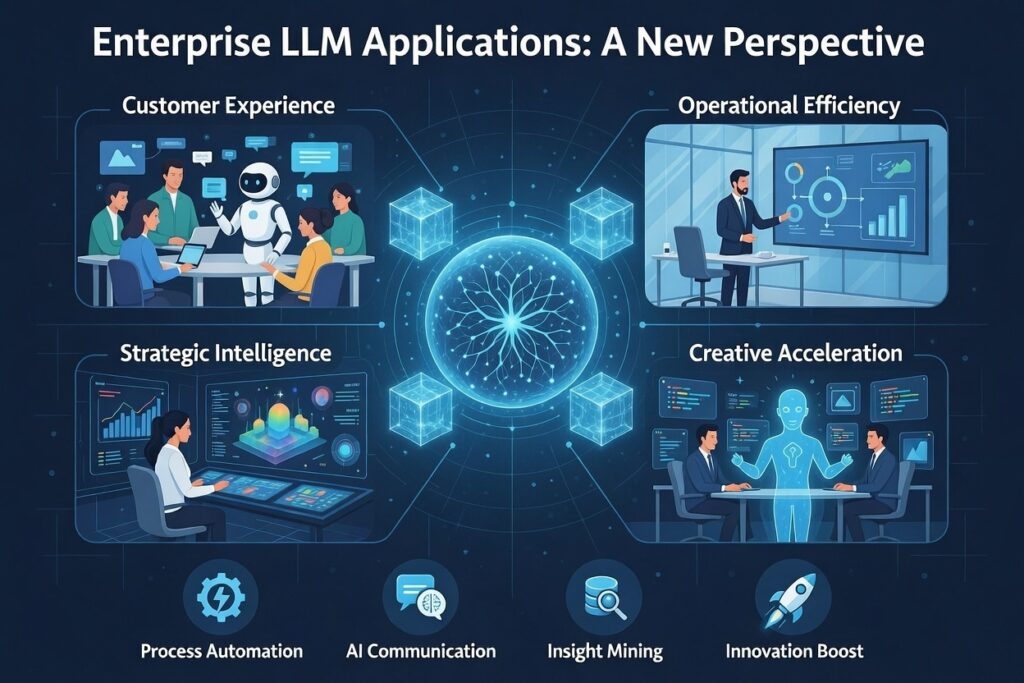
Large Language Models are reshaping enterprise operations across multiple dimensions. Their impact extends from customer engagement and internal efficiency to automation and innovation. As adoption matures, the competitive advantage lies not simply in using LLMs, but in integrating them intelligently to augment human capabilities and drive sustainable growth.